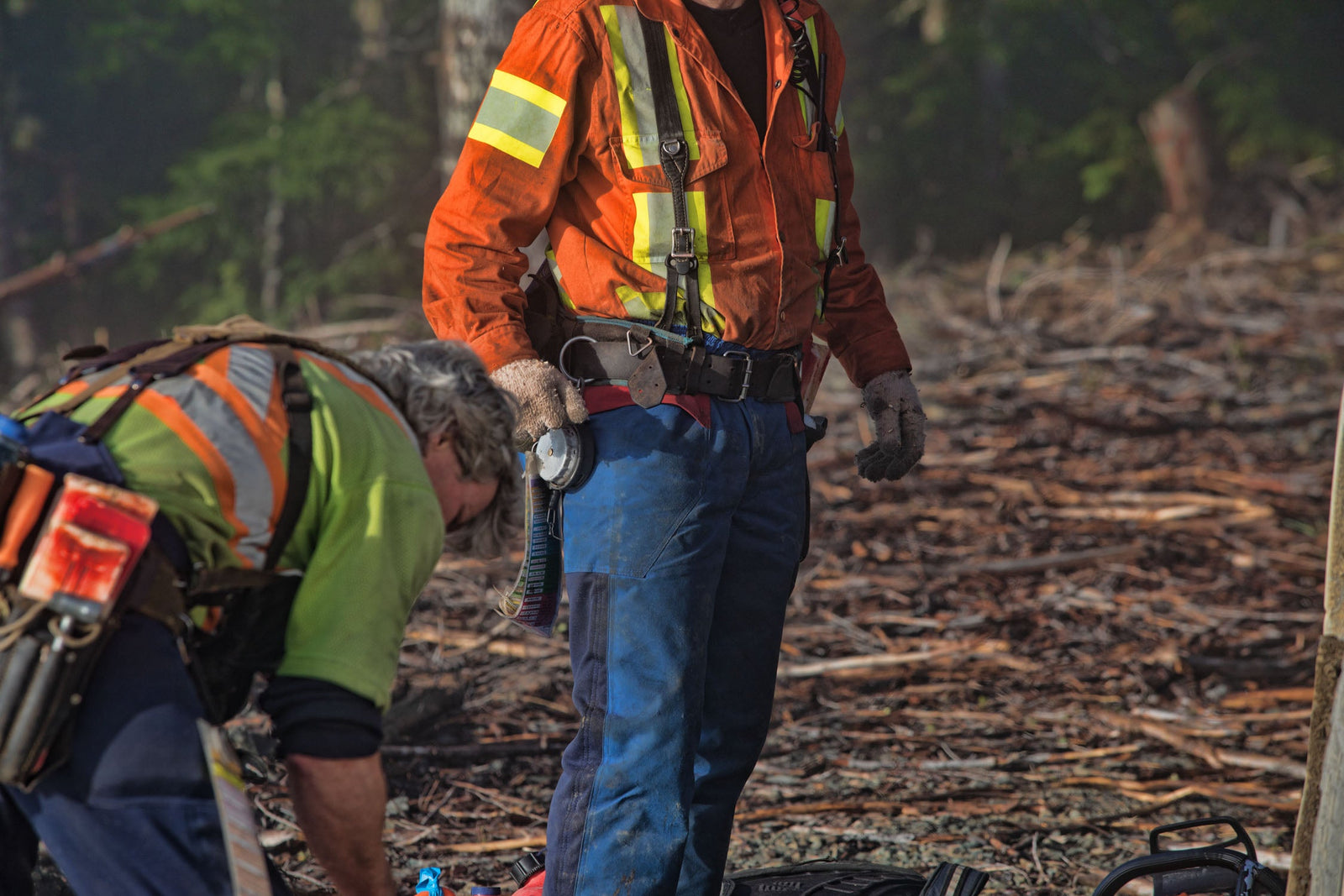
Every saw pant we build carries the same protection geometry: 180° front plus 4 inches on the left side of each leg, sewn in, from above the crotch to the ankle. So that is not the decision.
The decision is which shell goes over that pad, whether you need coverage up the back of the leg, and whether you should be buying a pant at all instead of chaps. Three questions, in order.
First: Pro or ProMax
Cut protection is described by threshold chain speed (TCS), a rating given in feet per minute. Our Pro build is rated at 3,600 ft/min on four layers of Kevlar. ProMax is rated at 4,100 ft/min on six.
Most crews run Pro and should stay there. Six layers means more fibre in the pad, and more fibre means more weight and more heat on a long day. Step up to ProMax when the exposure genuinely justifies it: slashing, seismic line work, high-production days with a big saw where the bar spends a lot of time near your legs.
Settle that once, then stop thinking about it. Everything below is about the shell.
Second: what the weather is doing to you
The shell is the part you feel all shift, and it is where most people buy wrong. They pick the toughest fabric in the lineup, then cook in it in August and stop wearing it.
- Summer Pro, $329.99. Cotton. The lightest, coolest pant we make, for heat.
- Faller's Poly Pro, $329.99. Stretch polyester with 360° give, 2.2 lbs in a 34-36. The most mobile pant in the line, built for climbers and arborists.
- Denim Pro, $349.99. 14 oz denim, for dry days and people who just want denim.
- Half 'n' Half Pro, $349.99. Water-resistant front, breathable back, for weather that cannot make up its mind.
- Hurricane Pro, $379.99. Waterproof nylon shell for coast rain, wet snow and standing water.
- Winterlined Pro, $449.99. The freezing-weather option.
- Rigger Pro, $349.99. Woven poly front and a reinforced seat patch, for brush and abrasion.
- Nomex Fire Pro, $729.99. Wildland fire work.
Pick for the eight months you actually work, not for the worst week of the year. If your season really does split, two pants beat one compromise.
Third: can the saw reach the back of your leg
The default coverage protects the front and the left side because that is where the cuts land. Right hand on the throttle, left hand on the bar, chain coming back at the left side of the leg.
Some work does not respect that pattern: slashing, brushing, feeding a chipper, bucking low with the saw behind your knee. Two models add a full-wrap 360° back pad from knee to ankle. The Faller's Poly Pro Backpad ($349.99) puts it on the Pro build. The Seismic ProMax ($449.99) puts it on the six-layer 4,100 build, with a 600D woven polyester front, a breathable knit back, a reinforced nylon seat patch and belt loops.
If the saw only ever runs in front of you, skip the back pad. You will feel the extra material and get nothing for it.


Five of the models named above.
Pants or chaps
Chaps strap over your work trousers, and that is the entire argument for them. It is a good argument if the saw comes out for twenty minutes at a time: firewood, storm cleanup, a utility crew that cuts occasionally. Ours start at $249.99 for the Chap Pro, with backpad and 4,100 versions above that.
If the saw runs most of the day, buy the pant. Chaps are one more thing to strap on, and gear that is fiddly to put on ends up staying in the truck.
Fit, which matters more than the spec sheet
Measure yourself and check the size chart on the product page rather than ordering whatever number is in your jeans. Sizing is unisex, and the charts give the garment measurement alongside the suggested range.
If the stock inseam is wrong for you, we change it. Alterations run $80 each and get added on the product page, because everything is sewn in house. The Hurricane Pro runs a 30" inseam on purpose, to sit above caulk spikes.
A pant that binds when you squat is a pant you will quietly stop wearing, and that is the only failure mode that matters.
What not to buy on
Layer count by itself. Six layers in the wrong shell for your climate is worse gear than four in the right one.
Pocket count. Where the pockets sit is the thing: hip pockets that stay clear when you bend, flaps that keep chips out.
Price alone, in either direction. We put that in its own piece on what the money actually buys.
The short version
Most crews: Faller's Poly Pro. Wet coast: Hurricane Pro. Highest exposure: Seismic ProMax. Occasional cutting: chaps. Climbing all day: read the arborist notes first.
The full spec-by-spec comparison lives in our Saw-Pant Protection Guide, and the whole lineup is at saw pants. Everything is handcrafted in Canada and comes with a 30-day risk-free trial and no restocking fee, so you can find out in the bush rather than in a change room.