
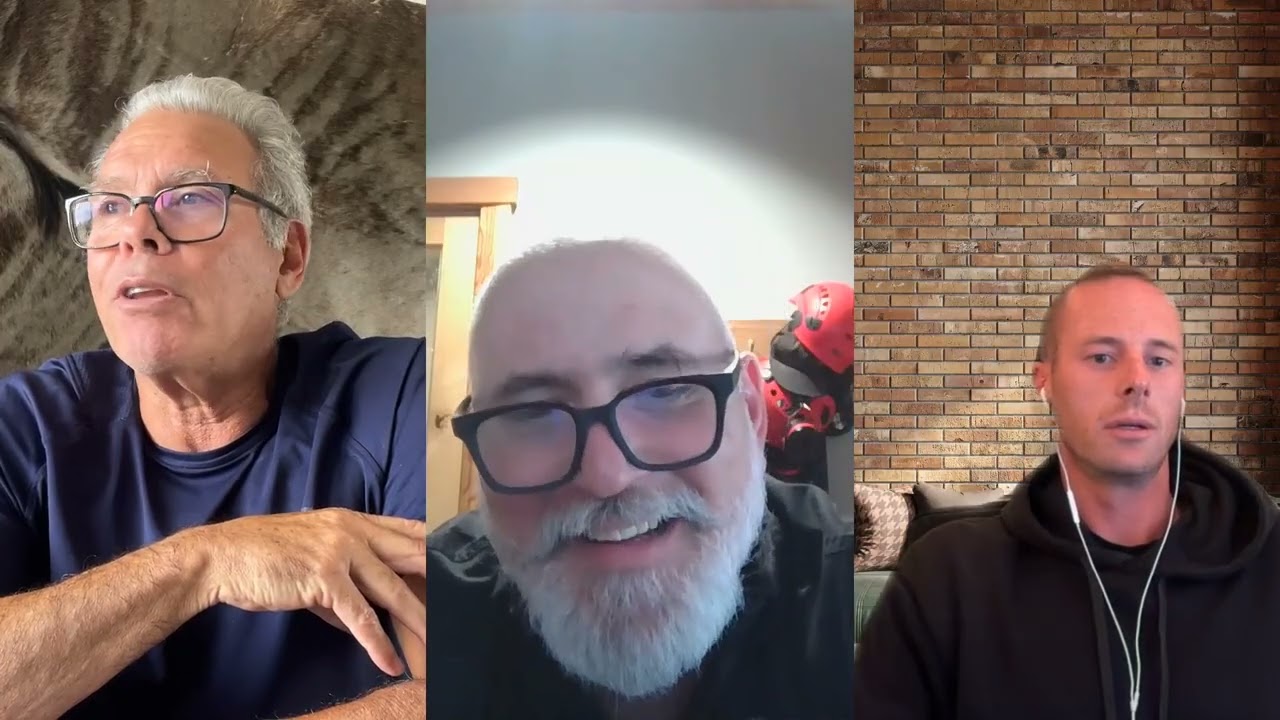
Three screens, one candid half hour. Rain Gear Pro founder Brian Payer and Keilan Clark got Andrew MacLellan on a call from Surrey, BC. Andrew is the Education and Training Manager at BC Plant Health Care, the Surrey tree care company that partnered with the US firm SavATree and now also goes by SavATree Canada. He spends his year driving the province teaching arborists, municipal crews and one-truck operators how to run a chainsaw, climb a tree, and get a hurt climber down without becoming the second casualty. The introduction came from Brian's son, and Brian's rule is that when his son recommends someone, he follows through.
This is the second in our In Conversation series: profiles of the people who build gear that lasts and, this time, of someone who teaches people how to come home in one piece. Same format as the first. No script, no polish. This one was recorded over a video call rather than in a room, after a first attempt to schedule it ran into Andrew being somewhere up the province running a course.
Watch the conversation
Runs 26:46. If the player doesn't load, watch it on YouTube.
From the bush to the classroom
Andrew came to arboriculture the sideways route. He trained as a forest technician and went into industrial forestry, which he describes as a boom and bust business, so he took faller training and fell timber between contracts. In one of the bust periods he took a job climbing trees around power lines as a utility arborist, discovered there was a big world in arboriculture, and became a certified arborist to stay on the tools and stay working with trees.
He is, in his own words, a refugee from Ontario. He came west hoping to climb for a company and send money home. BC Plant Health Care offered him a job in the consulting department, then asked him when he showed up whether he was interested in doing some chainsaw training. He said sure. That was nearly ten years ago.
I just did the war of attrition. I kept sticking around and kept doing training. Eventually they felt there was a growth opportunity in providing low-barrier, affordable safety training to the people in the industry that need it, and they gave me an opportunity to grow a business within a business: selling the same safety training the big companies enjoy to smaller companies and independent individuals.
He calls it one thing leading to another, and the stars and the moon lining up. The partnership with SavATree, the American tree care company, he describes as a trade: SavATree gets a window into the Canadian market and 25 years of programs the BC team developed, and the BC team gets the software and resources of a much larger organization. The two stay separate companies. His analogy is Mercedes-Benz and Mercedes-Benz Canada.
A third of it is chainsaw
Ask what the training side actually does and the answer starts with saws. About a third of everything they teach is chainsaw work, for municipal crews, companies and private individuals. The rest is the arborist's world: a week-long course in the fundamentals of safe tree climbing, advanced climbing, six or eight aerial rescue courses a year, rigging (the rope work, the equipment, the physics behind it), and equipment training for crews that have just bought their first aerial lift truck. The curriculum is built around WorkSafeBC and ANSI Z133.
We can't just focus on ourselves to make a safer industry. It's a small industry and we're all brothers and sisters in this. Everybody should have the same access to safety training. So we don't mind getting phone calls from a small business down the road that bought their first bucket truck, and we're perfectly happy to send trainers out to teach them how to safely operate it, maintain it, and how to deal with it when things go sideways on them.
Andrew covers the whole province himself, gets to Ontario once or twice a year for long-standing clients, and is looking at municipalities in Saskatchewan. Almost none of it comes from advertising.
It's mostly word of mouth. I might travel to Barriere, BC and do a chainsaw course. Then I'm up there doing chipper courses, and then all these other courses. It usually begins with an initial contact and then it spreads out. Neighbouring municipalities end up calling. It kind of starts like a wildfire.
What grows it, he says, is nurturing the relationships: listening to people, being honest about what is achievable, and feeding back to each client about where their team is at and what the next step should be.
What has changed, and what the internet broke
Keilan asked the question we most wanted answered. We spend a lot of time in the United States talking to arborists and fallers, and parts of the trade down there are still what he politely calls the Wild West, with plenty of guys wearing Kevlar inserts in their jeans. What has Andrew watched change over his career?
My goodness, when I started there was no education and training on it. The best I got was "wear these," and that's it. There was nothing to help me select appropriate safety equipment. I had no idea how it worked.
The newer generations, he says, are smarter, with more information and more tools for making safe decisions. There is far less argument about wearing PPE than there was ten or fifteen years ago, because people know now. The new problem is the flood of information itself.
They have the challenge of trying to separate what entertainment on social media and YouTube is from proper safety information.
Where people need the most help now, in his experience, is the why: why this make and model of chainsaw pants and not that one, and why the threshold speed of the saw matters when you are matching protection to the job. On skills, he thinks the internet has done real damage to the way the trade used to learn.
Before we had these things, we relied on vertical relationships with our co-workers to show us and teach us and temper us and slow us down. Right now they'll watch something on the internet, go to work, try it, and hurt themselves right away. Chainsaw training doesn't need to be expensive. Aerial rescue training doesn't need to be expensive. Let's get you the skills you need to move forward safely, because with more information sometimes comes poor decisions.
He is careful about the influencers. Some of them he knows and talks to, and he is grateful they get people interested in the trade. He is also blunt: they are not safe, and anyone who copies what they do is going to get injured.
Somebody's kid
Brian asked why, after all the miles, Andrew still loves the work. The answer is the reason this conversation belongs on our journal at all.
I feel like I'm making a difference. I've seen a lot of accidents. I've seen a lot of life-altering and life-ending accidents over the years. And I think that by doing this I'm honestly making a difference, because everybody is somebody's kid and brother and sister and friend. That's what keeps me getting up and moving forward.
He teaches with the evidence. He routinely cuts up old, retired chainsaw chaps in his courses to show people where the limits are. On the course he ran the day before we spoke, one participant pulled up his pant leg and showed the class the scar from cutting through his chaps years earlier. Andrew keeps a collection of cuts and scars on his phone as a teaching tool.
Keilan's side of that exchange is worth quoting too, because it is about as close as we get to a mission statement.
We operate online, so we're not face to face like you are. But when we get those emails saying, "Hey, your pants saved my life," it hits home. This isn't fashion. We're selling PPE. We're selling safety. At the end of the day we're that last line of defense, so if an accident does happen, they can get home to their families.
It had happened again two weeks before the call. Andrew's version of the same idea is shorter.
We're a tree company. In order to take care of trees, we need to take care of the people that take care of trees.
Watch the full conversation in the player above, or over on YouTube.
BC Plant Health Care, SavATree Canada, runs public and private courses from its training facility in Surrey, BC, and will come to you. For training, email learn@bcplanthealthcare.com, call the office on 604-575-8727, or find them at bcplanthealthcare.com and on Instagram at @bcplanthealthcare.
Our saw pants live here.