
Two Canadian manufacturers, one candid half hour. Rain Gear Pro founder Brian Payer sat down with Bill Challenger, President of Cannon Bar Works, in Bill's office in Langley, BC. The two met earlier this year through Westcoast Saw, kept talking after the show, and agreed to do it properly on camera.
This is the first in a series we're calling In Conversation: profiles of the people who build gear that lasts. No script, no polish. Just two people who have spent their working lives making things for people who work outside, talking shop for half an hour.
Watch the conversation
Runs 28:53. If the player doesn't load, watch it on YouTube.
Fifty-one years in the chainsaw business
Bill marked 51 years in the chainsaw business at the end of 2025. It started badly, by his own account. He dropped out of university four months in, back in 1969, and went to work in the bush on right-of-way crews. They broke him in falling. The money was really good, he says, and every Monday he was broke.
So he went back to school, graduated from BCIT in 1973, and ended up selling chainsaws for a distributor until 1979. That is where the story turns. At a golf tournament on Vancouver Island, a group of logging executives got to griping about how many saws they were buying. Bill told them the problem wasn't the saws, it was that nobody was looking after them, and that they should be leasing chainsaws the way they leased pickup trucks: full maintenance, someone else's job.
The gripe session turned into a business plan. His own boss thought it was about the dumbest idea he had ever heard. The logging executives disagreed, and when Bill told them he did not have the $85,000 of capital the plan needed, not with a wife, two young kids and a new mortgage, they lent him the money.
Leasing swept up and down the coast. At its peak, around 1991 and 1992, Challenger Chainsaw Services was running about 2,300 saws across 19 camps, each camp with its own mechanic. Those camps were Cannon's single biggest customer. So when Cannon went into receivership in 1997, Bill did the practical thing: he bought the assets from the receiver rather than lose access to the bars his fallers trusted, and started Cannon Bar Works.
The best bar, bar none
That is Cannon's own line, and Bill treats it as a standard to be met rather than a slogan. Ask him what actually makes the difference and he does not start with the machining.
It really starts with the steel. We're fortunate to have a relationship with a mill that will make small lots of steel for us, to my formula, my recipe.
From there it is a run of small decisions that add up. Cannon flame hardens its bars instead of induction hardening them, because flame is gentler and goes deeper, so the bars last longer. The rails come out harder than the chain parts riding on them, and that is deliberate: chain is the cheap part, so chain is what should wear out. Long bars and carving bars are still made by hand. And nothing gets painted.
We don't paint our bars. We put on a gunmetal finish because we want to show off that beautiful steel.
Then there is the warranty, which is unusual enough that Bill is not sure anyone else offers it.
We have an unlimited lifetime warranty on our product against defects in workmanship or material. I'm not saying you can't break it, and eventually you will wear it out. But if a defect shows up five years after they've had it, we'll replace it.
None of that is free, and Bill is straight about the economics. Cannon is specialized rather than mass-produced, working at a scale of thousands of bars a year rather than millions.
We're very specialized at what we do. Our bars will outlast mass-produced bars sometimes five or six to one. They're expensive: the upfront price you pay is sometimes double what a mass-produced bar would be. But it's easy math if it lasts four or five times as long. It takes a particular kind of value-conscious professional operator to recognize that.
Which is a polite way of saying Cannon is not really built for the homeowner. As Bill puts it, if you are cutting one cord of wood a year, a Cannon bar is the sort of thing you end up gifting to your grandchildren.
The range runs from 24-inch fallers' setups up to 84-inch ripping bars, plus arborist, carving, rescue and milling bars. That spread is what took Cannon around the world: these days only about a fifth of the business is in Canada.

The banner on Cannon's wall. Their words, their standard.
A family operation
Three people run Cannon, and two of them share Bill's last name. His wife Rose looks after HR and the accounts, and does all of the bar design in AutoCAD, a skill she picked up designing gardens before Bill redirected it toward chainsaw bars. Their youngest daughter Ashley is operations manager: once an order comes in it is hers until it ships. Bill handles the big picture, the sales and the marketing.
My wife is the vice president of everything, and the president reports to the vice president of everything.

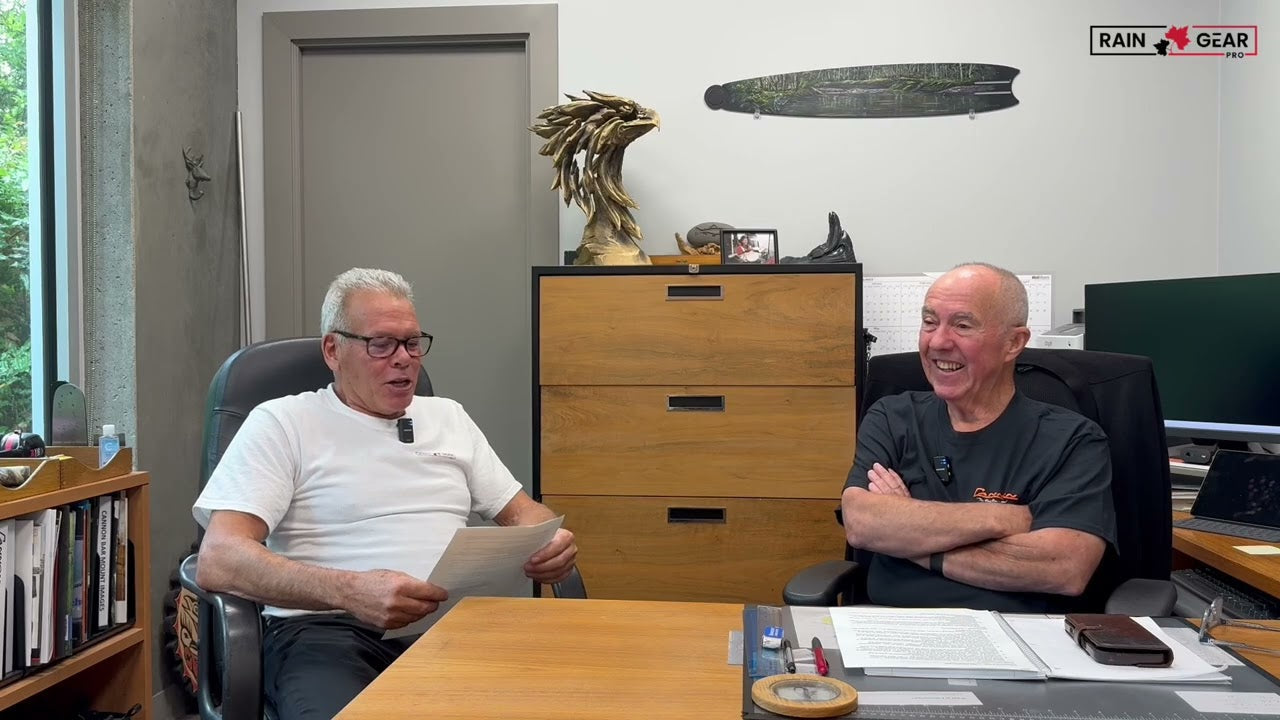
Brian and Bill in the office at Cannon Bar Works, Langley, BC.
We are a family business too, which is honestly half the reason this conversation happened. Brian asked what is left to achieve after all these years, and got an answer that explains why Bill is still in the building.
Achievement is, in my opinion, the key to happiness. That's why I'm 75 years old and I'm still set on achieving stuff. It's making me happy, and I'll keep doing it as long as it continues to make me happy.
Back to the '80s
Right at the end, unprompted, Bill tied Cannon back to our own history. Canswe is the family business behind Rain Gear Pro, and it turns out the two companies have met before.
It's been a real pleasure reconnecting with your family business. It was probably in the '80s that we first got introduced to Canswe, providing rain gear to the fallers at some of our camps. We go back a long way.
Nearly forty years later, the two crews are back in a room together.
Watch the full conversation in the player above, or over on YouTube.
Cannon Bar Works builds its bars in Langley, BC. You can find them at cannonbar.com.
Our saw pants live here.