
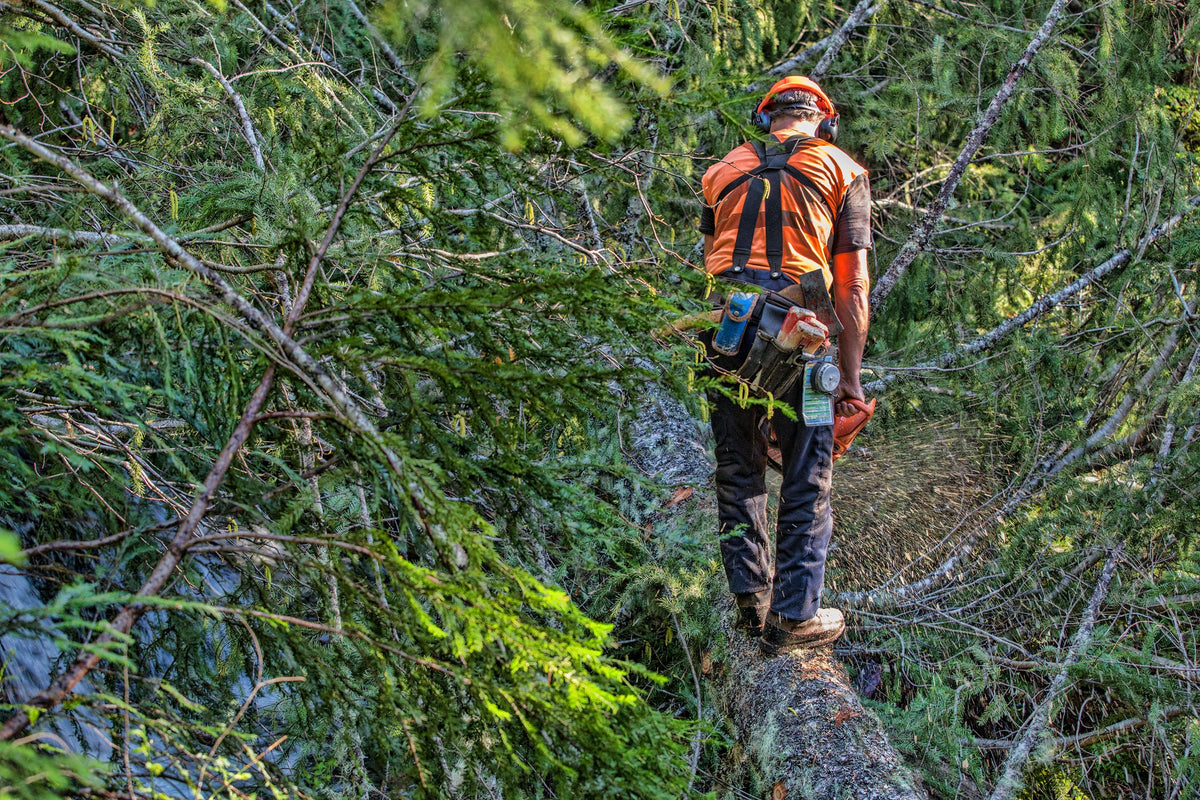
An arborist's week is two different jobs, and they want different things from a pant. Aloft you are hanging in a saddle, moving in three dimensions, cutting close to your own body. On the ground you are dragging brush, feeding a chipper and bucking wood with the saw low.
Most buying advice ignores that and tells you to get the toughest pant available. Here is the version that accounts for both halves of the job.
Aloft, the pant sits under your saddle
That one fact drives most of the decision, and it is the thing a spec sheet will never tell you.
What you notice on a long hang is bulk at the hips and thighs, because that is where the saddle and the leg loops are loading you. Before you buy, look at where the pockets sit and how the flaps lie. A hip pocket that clears your leg loops is fine. A loaded thigh pocket under a loop becomes a pressure point about two hours in, and you will spend the rest of the day shifting to get away from it.
The other thing you notice is stiffness. On the ground a heavy shell is free protection. Aloft it fights you every time you push off, foot-lock or reposition, and fighting your trousers is how you get tired. Stretch matters more aloft than abrasion resistance does.
Weight compounds the same way. Our stretch polyester pant runs 2.2 lbs in a 34-36. Everything you climb with, you climb with all day.
Boots and blue saw pants working up a marked stem, saddle leg loops loading the hips and thighs. Video: @_axe_contracting
The pant most climbers land on
The Faller's Poly Pro ($329.99) is the one we build for this work: a 100% stretch polyester shell with 360° give, hip pockets positioned to stay clear when you bend and cut, and flaps that keep chips out. Four layers of Kevlar, rated at 3,600 ft/min threshold chain speed.
If your problem is heat rather than movement, the Summer Pro is cotton and the coolest thing we make, at the same price. If your exposure genuinely warrants six layers, the Faller's Poly ProMax ($379.99) is the same stretch shell rated at 4,100 ft/min, at the cost of some weight.
Coverage is the same across all of them: 180° front plus 4 inches up the left (bar) side, sewn in, from above the crotch to the ankle. That is the geometry a top-handle saw is most likely to test, since the cut is usually happening in front of you and close in.
Taking limbs off on the way down the stem. Video: @joseph_of_the_ozarks
Chaps and climbing lines
We sell chaps and they are the right call for plenty of work. Climbing is not that work.
Chaps strap over your trousers, which means straps and buckles sitting on your legs alongside a climbing system. That is more hardware to hang up, more to check before you leave the ground, and one more thing to fumble at height. Ours use a closed front specifically to cut down on snags, and it still holds: if you climb, wear the pant and keep the chaps for quick ground cutting.
On the ground, the risk moves
Ground work turns the problem around. Now abrasion is real, kneeling is constant, and the saw spends time low, behind your knee and pointed the wrong way.
If the saw can reach the back of your leg, get coverage there. The Faller's Poly Pro Backpad ($349.99) adds a full-wrap 360° back pad from knee to ankle to the pant you already like climbing in. The Seismic ProMax ($449.99) puts that back pad on the six-layer 4,100 build with a 600D woven polyester front and a reinforced nylon seat patch, which is the right tool for a crew doing heavy brushing and slashing rather than tree work.
For ground days that are mostly brush and machinery, the Rigger Pro ($349.99) trades stretch for a woven poly front and a reinforced seat.
Boots, spikes and inseam
Hem length is the detail arborists get wrong most often. Too long and the cuff rides over your boot, catches on gaffs and wears through at the heel. Our Hurricane Pro runs a 30" inseam for exactly this reason, to sit above caulk spikes.
If the stock inseam is not right for you, we alter it: $80 per alteration, added on the product page, sewn in house. Worth doing once rather than working around it for three years. Measure yourself and check the chart on the product page instead of ordering by your jeans size, and remember the sizing is unisex.
Kitting a crew
If you are buying for more than yourself, the split that works is simple. Climbers in the stretch pant. Ground crew in the backpad version or the Rigger, depending on whether their day is saws or brush. One or two pairs of chaps in the truck for the guy who only cuts occasionally.
Then treat all of it as safety equipment rather than clothing: inspect after each use, keep it out of the bar oil, and replace any pair where a chain nick has reached the Kevlar pad.
Everything relevant to tree work is collected in Felling & Arborists, and the coverage and rating detail is in our Saw-Pant Protection Guide. Every pair is handcrafted in Canada and carries a 30-day risk-free trial with no restocking fee, which for this job means a month of real climbing before you decide.